The right machine depends on more than the headline pressure: water flow, electrical capacity, soil adhesion, vehicle surfaces and daily washing volume all change the result. By comparing the correct model variants and checking your water, drainage and three-phase supply, you can choose a washer that cleans quickly without damaging paint or starving its pump.
Key takeaways
- Confirm the complete model, voltage and phase on the nameplate.
- Choose higher flow when fast rinsing matters more than peak pressure.
- Use lower pressure and wider spray distance near paint, seals and electrics.
- Check water supply, drainage and three-phase power before installation.
Confirm the exact 10/25 and 7/16 variants before comparing them
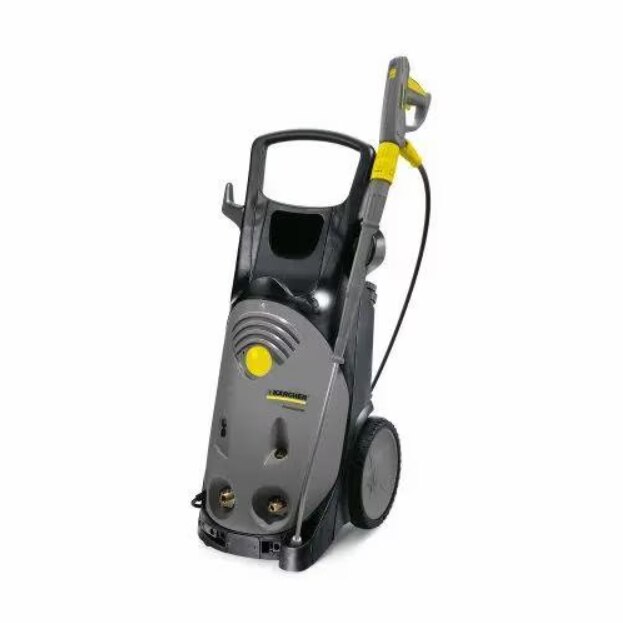
“10/25” and “7/16” identify pump classes, not complete machines. A useful karcher 10 25 pressure cleaner comparison, like a karcher 7 16 pressure cleaner comparison, starts with the full model and the voltage and phase printed on its nameplate.
HD 10/25-4 S and HD 7/16-4 M are example identifications; suffixes can change pressure, flow, accessories, dimensions and duty rating.
| Specification | 10/25 class | 7/16 class |
|---|---|---|
| Operating pressure | About 250 bar | About 160 bar |
| Rated water flow | About 1,000 L/h (16.7 L/min) | About 700 L/h (11.7 L/min) |
| Motor rating | About 9.2 kW | About 4.2 kW |
| Nominal hydraulic power | About 6.9 kW | About 3.1 kW |
| Electrical supply | Confirm voltage, phase and current from the nameplate | Confirm voltage, phase and current from the nameplate |
| Hose and nozzle | Confirm length, nozzle orifice and spray angle | Confirm length, nozzle orifice and spray angle |
Treat those figures as reference values, not a quotation. Ask the seller to state each item below for the exact suffix:
- Operating pressure and maximum allowable pressure
- Rated flow, motor power, voltage, phase and current
- High-pressure hose length, nozzle type and inlet-water limits
- Total weight, warranty terms, duty rating and local service availability
Compare water flow as carefully as bar: flow carries loosened mud away and speeds rinsing across a vehicle. A headline “250 bar versus 160 bar” alone can select the wrong washing-bay machine.
Pressure breaks dirt loose, but flow determines how fast you rinse
A 250-bar pump breaks dried clay and quarry dust loose, but water flow decides how quickly you carry that dirt away. For the karcher 10 25 vs 7 16 pressure cleaner in nashik decision, compare usable cleaning rate rather than the headline pressure.
| Option | Water flow | Effect on washing | Cost consequence |
|---|---|---|---|
| Kärcher 10/25 | About 1,000 litres/hour, or roughly 16.7 L/min | Rinses truck bodies, chassis rails and undercarriages faster; handles strongly bonded mud better | Needs faster tank refill, more water and higher motor-energy consumption |
| Kärcher 7/16 | About 700 litres/hour, or roughly 11.7 L/min | Suits routine vehicle washing but takes longer on large or heavily soiled equipment | Uses less water and electrical capacity, with lower utility load per hour |
Motor power supports both pressure and sustained flow. Ask for the rated kilowatt load, voltage and phase; a higher rating raises electricity cost, but a smaller motor that forces longer washing can increase labour cost instead.
A 2,000-litre tank provides about two hours of continuous supply at the 10/25’s rated flow, before other water use. If your bay cannot refill at that rate, the pump will wait or run short. Detergent application is separate: use a foam lance or downstream injector for even coverage, then rinse with clean water.
Thick foam alone does not prove faster cleaning.
Match each machine to cars, trucks, buses and construction equipment
Passenger cars usually suit the 7/16. Its lower water and electrical demand is easier to manage, and its gentler output is more practical around paint, glass, decals and rubber seals. Choose the 10/25 when the bay must process many vehicles per shift rather than occasional cars.
| Machine | Best fit | Why | Main limitation |
|---|---|---|---|
| 7/16 | Cars, pickups, tractors and moderately dirty JCBs | Lower utility load and about 700 litres per hour; practical where portability and water availability matter | Takes longer on chassis rails, underbodies and packed clay |
| 10/25 | Trucks, buses, tippers and concrete mixers | Higher flow, up to about 1,000 litres per hour, carries loosened mud across large panels and frames faster | Needs stronger water supply, drainage and electrical capacity |
| 10/25 | Excavators and heavily soiled JCBs | Better for dried black-cotton soil, quarry dust and compacted underbody mud | Do not aim maximum pressure at seals, radiators or exposed electrics |
For a pressure washer for JCB cleaning, select the 10/25 only when adhesion, wash frequency and machine count justify its water demand. A lightly soiled excavator cleaned weekly may be better served by the 7/16.
For a truck washing machine in Nashik, compare completed vehicles per hour, not maximum bar. Use detergent separately through a downstream foam injector or foam lance, then rinse with clean water; thick foam alone does not prove greater cleaning power.
Protect paint, glass, seals and electrical components during washing
A karcher 10 25 pressure cleaner comparison matters most at the nozzle, not the nameplate. Use 250 bar for compacted, dried mud on robust chassis rails, dump bodies, undercarriages and construction equipment. Its stronger impact breaks adhesion faster, but it does not make painted panels safer.
| Washing area | Safer setting and method | Main risk |
|---|---|---|
| Paint, decals and glass | Lower pressure, wide fan, 30–50 cm stand-off; test an inconspicuous spot | Peeling clear coat, lifted decals or cracked glass |
| Door, window and wheel-hub seals | Lower pressure; keep the lance moving and avoid edge-on spraying | Water forced past seals |
| Radiators and electrical areas | Wide fan, greater distance and reduced pressure; spray across fins, not into them | Bent fins, alternator damage or connector intrusion |
| Dried mud on chassis and underbody | Higher pressure, controlled distance and a suitable fan nozzle | Damage when the jet reaches hoses or wiring |
Never hold a narrow jet close to damaged paint, tyre sidewalls, radiator fins, alternators, starter motors, connectors or seals. Pre-rinse loose grit, apply detergent separately, and let the chemical dwell before rinsing; blasting dry grit directly across paint creates scratches.
Use 250 bar where dirt adhesion demands it. Choose lower pressure, greater stand-off distance and a wider fan for passenger-car panels, glass, trim and vulnerable components. Damage often comes from distance and angle, not pressure alone.
Check Nashik’s water system and three-phase installation before purchase
A washing bay must prove it has enough water, drainage and electrical capacity before either machine arrives. Complete this installation checklist:
1. Size storage against actual flow. A 10/25-class unit can use about 1,000 litres per hour; a 7/16-class unit uses about 700 litres per hour. A 2,000-litre tank therefore gives roughly two hours of continuous 10/25 operation before other users and refill delays. Confirm the pump and municipal or borewell refill rate.
2. Test the inlet at the machine, not only at the tank. Check pressure, hose diameter, shut-off access and the manufacturer’s inlet-water limit. Fit a washable sediment filter and clean it before commissioning; sand or scale can damage the inlet valve and pump.
3. Build drainage for muddy runoff. Provide a grated, non-slip floor, a silt trap and an oil separator before discharge. Do not send clay, diesel residue or detergent directly into a storm-water drain.
4. Have an electrician verify a stable 400–440 V, three-phase supply, earthing, cable size, isolator and coordinated overload and short-circuit protection. A 10/25-class motor needs substantially more capacity than a 7/16-class unit; read the exact nameplate before finalising the panel.
5. Obtain hose length, nozzle specification, inlet limits, warranty and local service response in writing. For a truck washing machine in Nashik, hose reach and downtime matter as much as headline bar.
Sahas Utility Services can record these checks during a site survey before quoting the karcher 10 25 vs 7 16 pressure cleaner in nashik.
Related products
 | High Pressure Cleaner Karcher 7/16 High Pressure Car Washer Max. Pressure 180 Bar Power 3000 Watt Flow Rate 8 L/min Motor Rating 5 HP Motor Speed 1450 rpm Application Area Car & Truck Cleaning Motor Phase... View product → |
 | High Pressure Cleaner Karcher High Pressure Jet Cleaners 10/25 Pressure 250 Bar Power 5000 Watt Flow Rate 12 L/min Motor Rating 7 HP Power Source Electric Motor Motor Phase Three Phase Voltage 400-440V Warranty 6... View product → |
Frequently asked questions
What must you confirm before comparing Karcher 10/25 and 7/16 machines?
Confirm the complete model designation, operating pressure, water flow, voltage and phase printed on each nameplate. The 10/25 and 7/16 figures identify pump classes rather than complete machines.
Which matters more for vehicle washing: pressure or water flow?
Pressure breaks dirt loose, while water flow determines how quickly you rinse loosened soil and detergent away. Compare both figures for the work you do.
Which machine suits cars, trucks, buses and construction equipment?
Match the machine to vehicle size, soil load, washing frequency and available water. Cars need controlled cleaning near paint and trim; trucks, buses and JCB equipment benefit from faster rinsing when mud loads are high.
How do you protect vehicle surfaces while pressure washing?
Keep the nozzle moving, use an appropriate spray pattern and distance, avoid forcing water into seals and electrical connectors, and use lower pressure around paint, glass and fragile components.
What should you check at a Nashik site before buying a pressure cleaner?
Check the incoming water flow, tank and filtration arrangement, drainage capacity, electrical voltage, three-phase availability, cable protection and the machine's installation requirements.
Keywords