

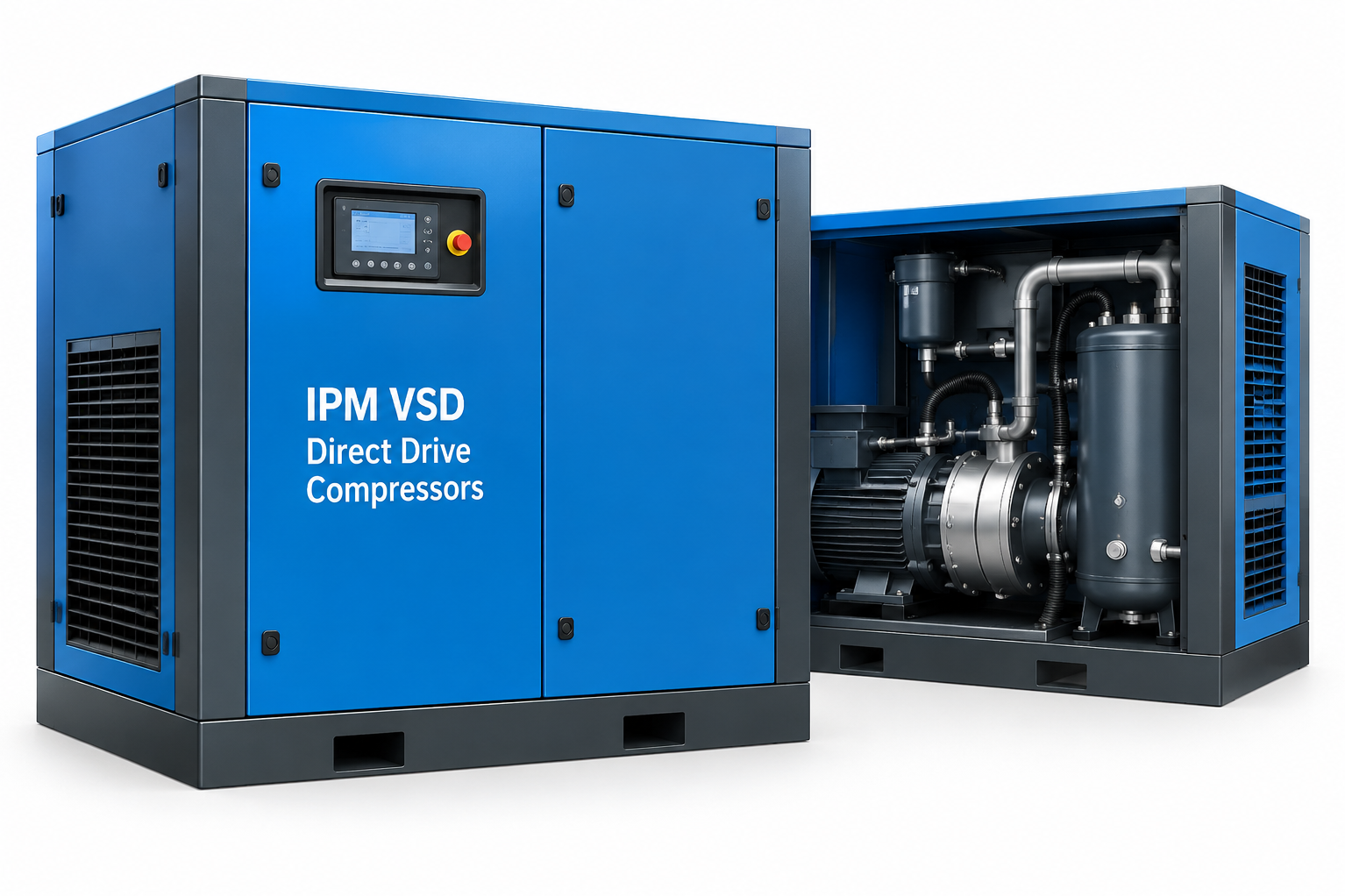
Industrial facilities rarely consume exactly the same quantity of compressed air every minute of the working day. Production machines start, stop, load, unload, plus change according to shifts or process schedules. IPM VSD Direct Drive Compressors are designed for applications where responding efficiently to changing compressed-air demand is an important consideration.
For manufacturing facilities in Nashik, Maharashtra, understanding variable-speed technology can help decision-makers evaluate whether it fits their production profile.
Why Variable Demand Matters
Traditional compressor selection often begins with maximum demand. While peak capacity is important, a facility may spend substantial operating time below that peak.
For example, a production unit may have high compressed-air consumption during the main shift but significantly lower consumption during setup, breaks, reduced production, or secondary shifts.
If compressor output remains poorly matched to demand during these periods, unnecessary energy consumption may occur.
What VSD Technology Does
Variable speed drive technology allows compressor motor speed to adjust according to compressed-air demand within the designed operating range.
When demand falls, the system can reduce output. When demand increases, compressor output can respond accordingly.
This capability can be particularly useful where air consumption fluctuates regularly.
However, VSD technology should not automatically be treated as the right answer for every factory. A facility operating close to a stable full load for most of the day has a different demand profile from one experiencing frequent variation.
Understanding IPM Motor Technology
IPM refers to interior permanent magnet motor technology.
The motor design is intended to support efficient operation, particularly when integrated with variable-speed control. Direct-drive configurations also reduce the number of mechanical transmission components between the motor plus compressor element.
From a buyer's perspective, the technology should be evaluated according to operating efficiency, maintenance requirements, expected duty profile, service support, plus total lifecycle cost.
Start With an Air-Demand Study
Before investing in variable-speed equipment, businesses should understand how compressed-air consumption changes throughout the day.
Useful measurements include:
- Average airflow
- Minimum demand
- Peak demand
- Operating pressure
- Production shift patterns
- Unloaded running time
- Existing compressor utilisation
- Expected future capacity
This data provides evidence for deciding whether variable-speed operation is likely to be useful.
Energy Savings Depend on the Application
It is tempting to associate VSD automatically with a fixed percentage of energy savings. Actual results depend on the system.
Savings potential can be influenced by load variation, pressure settings, compressor sizing, leakage levels, control strategy, operating hours, plus the efficiency of the overall compressed-air network.
A facility with severe leakage may gain more immediate value by repairing leaks before changing compressor technology.
Similarly, unnecessarily high pressure settings can increase energy consumption regardless of motor design.
Direct Drive Can Simplify Power Transmission
Direct-drive arrangements connect the drive system without relying on certain traditional transmission components.
This can influence maintenance requirements plus power transmission characteristics. Buyers should still examine the complete machine rather than focusing on one feature.
Cooling design, controls, filtration, service accessibility, operating environment, plus after-sales support remain relevant.
Sahas Utility Services supports industrial compressed-air requirements in Nashik where modern compressor technologies may be considered according to facility demand.
IPM VSD direct drive compressors are best evaluated through actual operating data. For factories experiencing meaningful fluctuations in air consumption, variable-speed technology may provide a way to align compressor output more closely with production demand. The strongest purchasing decision comes from measuring the system first, identifying inefficiencies, then selecting technology that addresses the real operating pattern.