

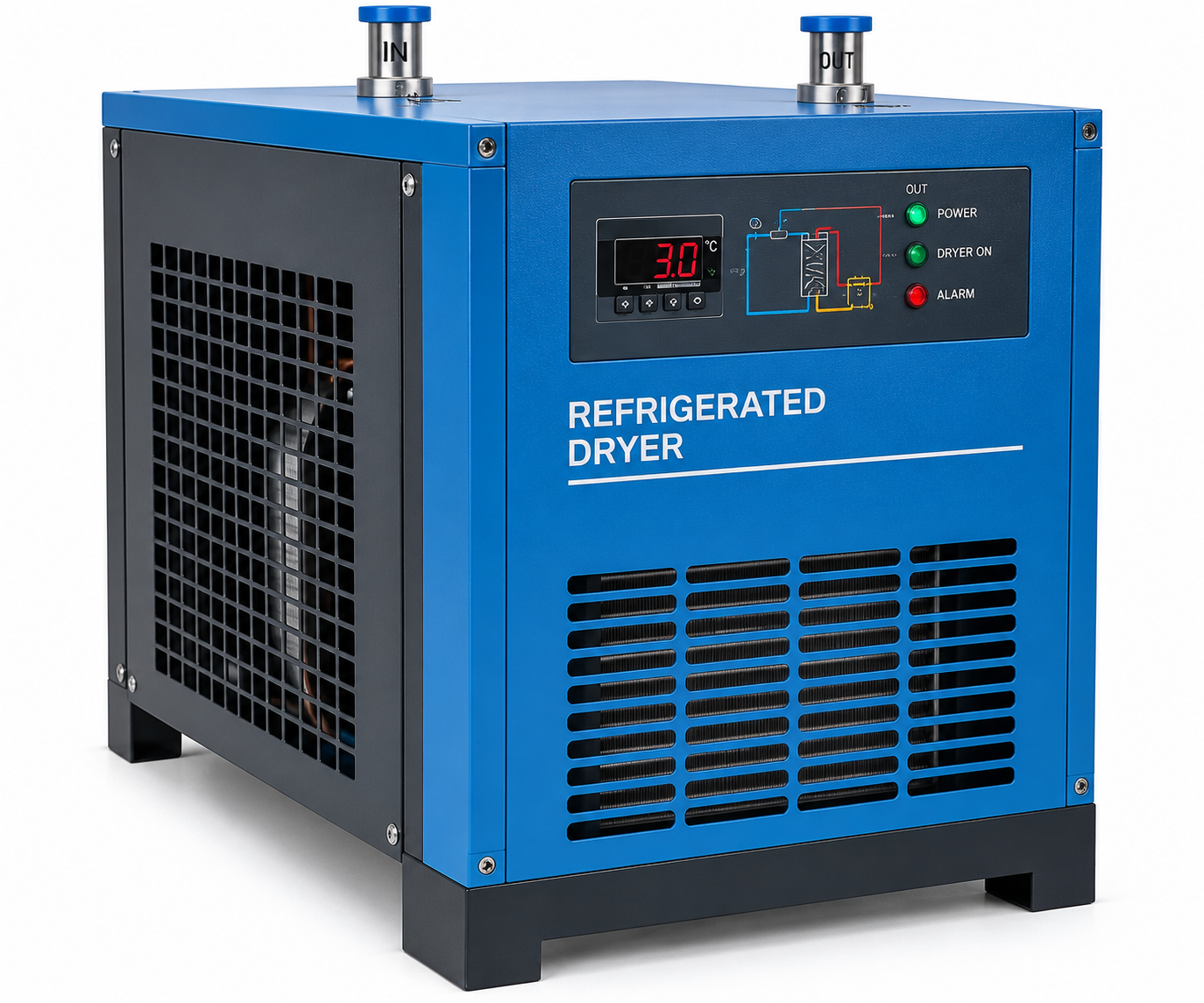
Moisture is one of the most common challenges in compressed-air systems. A Refrigerated Dryer is used to reduce moisture within compressed air before it reaches downstream equipment, helping industrial facilities maintain more consistent air quality.
For factories, engineering businesses, automotive facilities, workshops, plus manufacturing units in Nashik, Maharashtra, moisture control can be important for equipment reliability plus process performance.
Why Compressed Air Contains Moisture
Atmospheric air naturally contains water vapour.
When air is compressed, its temperature rises. As compressed air subsequently cools, some of the water vapour can condense into liquid moisture.
Without suitable management, condensate may travel through piping toward production equipment.
Possible consequences include:
- Corrosion within pipelines
- Water reaching pneumatic equipment
- Reduced reliability of certain tools
- Problems in surface-finishing applications
- Contamination concerns
- Increased maintenance
- Damage to sensitive downstream components
The severity depends on the application plus environmental conditions.
How Refrigerated Drying Works
A refrigerated compressed-air dryer lowers the temperature of compressed air so that moisture condenses.
The separated water can then be removed before the air continues through the distribution system.
This approach is widely used for general industrial compressed-air applications where an appropriate pressure dew point can satisfy process requirements.
However, not every industrial application has identical air-quality needs. Processes requiring extremely dry compressed air may require another treatment approach.
Dryer Capacity Should Match Actual Conditions
Selecting a dryer simply according to the compressor's nominal capacity can be misleading.
Actual dryer performance may be affected by:
- Inlet air temperature
- Ambient temperature
- Operating pressure
- Airflow
- Compressor operating conditions
- Required air quality
Industrial facilities should therefore evaluate real operating conditions when selecting dryer capacity.
A dryer working outside its intended conditions may struggle to deliver the expected moisture control.
Drainage Is Part of the System
Removing moisture from compressed air is only useful when collected condensate is properly discharged.
Drain systems should be inspected periodically to ensure they function correctly. Blocked or malfunctioning drains can allow accumulated moisture to create additional system problems.
Maintenance teams should include drains within routine compressed-air inspections rather than treating them as minor accessories.
Filtration Also Deserves Attention
A dryer addresses moisture, but compressed-air quality may involve additional contaminants.
Depending on the application, filters may be required to manage particles, oil aerosols, plus other contaminants. The correct treatment arrangement should be determined by the required air quality at the point of use.
Adding unnecessary treatment equipment can increase pressure drop plus operating cost, while insufficient treatment can expose production equipment to contamination.
The objective is appropriate treatment rather than maximum treatment.
Signs That Moisture Control Needs Attention
Facilities should investigate when operators notice water at air outlets, corrosion within piping, recurring pneumatic component problems, inconsistent finishing results, or frequent drainage issues.
These symptoms do not automatically prove that the dryer is incorrectly selected. They may also indicate drainage problems, overloaded treatment equipment, excessive inlet temperatures, bypass conditions, or maintenance issues.
Sahas Utility Services works with industrial customers in Nashik evaluating compressed-air equipment plus supporting air-treatment requirements.
A refrigerated dryer can play an important role in protecting a compressed-air network, but its effectiveness depends on correct sizing, operating conditions, drainage, filtration, plus maintenance. Businesses that evaluate these factors as one system can make more informed decisions about compressed-air quality while avoiding unnecessary treatment costs.